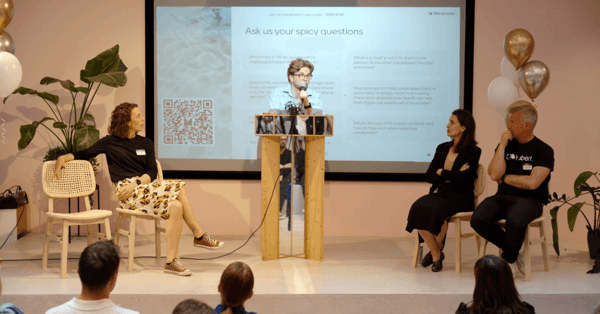
At our recent summer mingle, we handed the mic to four seasoned HR professionals and asked them to share honest, unfiltered takes on some of the most polarizing questions in hiring today. From AI chatbots to overrated recruitment metrics, bias in hiring, and what we should stop doing altogether — no topic was off-limits.




Q: Are we going too far in trying to humanise AI in recruitment—making it feel like a person, even though we know it’s not?
Fredrik: No, I don't think so. I think candidates want to interact with chatbots that have a personality. Science is evolving to better understand how chatbots should behave when interacting with humans, and it'll be super interesting to see how that develops.
I think we, as humans, will get progressively used to having conversations with various digital agents, and it will only become more important that these agents have a name and a personality.
Emira: I like to think of these bots not as 'digital colleagues' but as user interfaces for AI. Still, it would be really cool to design an agent with a personality based on the Five-Factor Model, for example. And just to see how it differs when interacting with a bot that is really high on neuroticism, versus one that is more stable.
Q: Are personality tests elitist–where only the “top performers” are actually able to get jobs?
Linnea: "Not necessarily. If every company looked for the same profile then yes, it could create bias and only certain people would be matched to all jobs. But that’s not the case. Different roles demand different profiles. They give us data on what someone is like and whether that aligns with the demands of a specific job. And if you call that elitist, I would say maybe it's fair to actually find the people that are most suitable for that job."
Q: What’s the most overrated hiring metric, and what should we track instead?
Alex: "Time to hire. It’s easy to track, but it doesn’t tell you much about how successful someone will be in the role. Like hiring someone based on internal recommendations, obviously goes fast, but was it a successful hire? We should be measuring time to productivity instead—how quickly someone ramps up and starts contributing meaningfully, how quickly they reach their targets or KPIs. That’s what really impacts the business.
Linnea: "I think we put too much weight on retention. We assume high retention is always good, but what if the wrong people are staying? I think it can be problematic when we always assume that high retention is fantastic. That’s only true if you have the right people in the company.”
Q: Are references actually useful? Don't they add bias to the recruitment process?
Emira: "I think it’s really important to verify the information you get from candidates. Right now, the recruitment process relies almost entirely on a single source: the candidate themselves — who is, of course, biased because they want the job.
So, of course, references are biased because they are chosen by the candidate. We can’t get completely objective data, but we can challenge the single, most biased source of all."
Q: Should candidates be allowed to use AI in the recruitment process? And what counts as cheating when candidates use AI?
Fredrik: "At Hubert, we detect about 7-8% of candidate responses are generated by AI–and we expect that number to grow dramatically in the coming years. But how much of that actually counts as cheating?
Some of our clients are fine with candidates using AI, as long as the candidate can back up their answers in interviews.
But then again, isn’t that already the case? There's plenty of "cheating" in CVs too, and it's up to recruiters to validate that information through data and the process itself.
Emira: "Cheating has always existed, just in different forms. So what actually counts as cheating? Is it dressing differently than you normally would for an interview? Or Googling interview prep questions? It's all part of trying to present yourself in the best light. That’s why we say: trust, but verify. Use multiple data points to build a more complete picture of the candidate."
Linnea: "Right now, AI isn’t very good at gaming psychometric or logic assessments. Could that change? Sure. But when it comes to the bigger question of using AI to ‘cheat’ on tests—of course it's possible, just like with any step in the recruitment process.
Someone else can write your CV—maybe it’s not AI, but it's still someone other than the candidate. You can build in functionalities to verify candidate identity, but those can become very intrusive and lead to a poor candidate experience. So it’s a balancing act."
Q: If we’re being honest, doesn’t using AI hurt the candidate experience?
Fredrik: Yes. That is my clear answer. I think you should bear in mind what kind of AI you are using and where in the process. Some applications of AI will definitely decrease the candidate experience compared to a human, personal interaction.
One customer told me, “Every candidate wants to meet the hiring manager directly.” AI can’t replace that, but it is also not realistic that every candidate can meet the hiring manager. So definitely use AI where it's suited and where it makes sense.
That said, there are many parts of today’s recruitment processes where I genuinely believe AI can improve the candidate experience. Many candidates never receive feedback, for instance. They just get an auto generated email rejecting them without an explanation. AI can do a lot to personalize that type of feedback.
Q: What’s one thing AI should never replace?
Linnea: "The final decision. AI can help shortlist or support the process, but the hiring decision itself should always be made by the hiring manager or team. You can leverage AI, but the decision should be left to a human."
Emira: "When it comes to AI in recruitment, I think this is a challenging time. Because let's not forget: candidates are also using AI tools as well to boost their applications. There's an arms race on both sides, where AI is screening AI. I think we have to be very creative to solve that problem.
So if you reverse the question: what's the one thing we don't think candidates should use AI for? Is it okay for them to use AI to write CVs, to write their personal letters, or perform digital interviews?
If we don't accept an AI candidate bot, should we then accept a recruiter interview bot? I think that's worth thinking about, as well."
Alex: "And let's call it what it is. A lot of what people call 'AI' is really just automation. There's a difference. Automating tasks is great, but truly intelligent, adaptive systems are another level entirely. So we need to stop talking about AI when we mean automation."
Interested in more events like this? Stay in the loop by signing up for our newsletter or following us on LinkedIn.